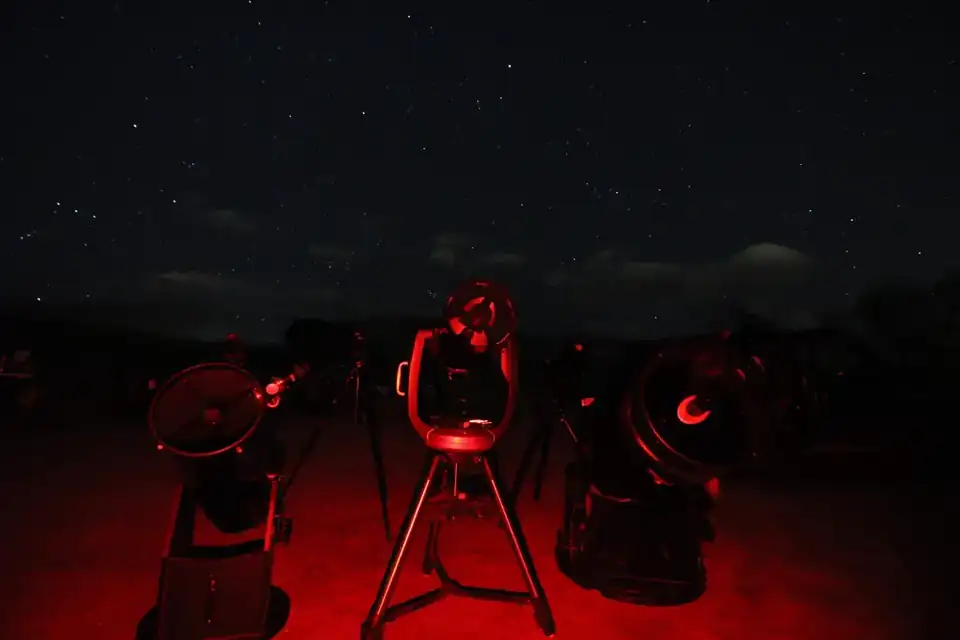
The Planetary Society's beginner guide starts with a useful premise: “You don’t need a telescope to stargaze.” The best destination depends on what you want to do under the sky, not on one darkness score.[2]
I want the Milky Way
Choose a dark site with a useful horizon, little direct white light and time for your eyes to adapt. Great Sand Dunes notes that the Milky Way is easiest when the Moon is absent or faint and the sky has had time to become fully dark.[3]
I want a photograph
For a nightscape, the foreground and a stable tripod matter alongside sky darkness. NASA's meteor-photography guide tells photographers to get away from city lights, use a tripod, use a wide-angle lens and focus manually; the same basics apply to many beginner star-field photographs.[4]
I brought a telescope
A telescope needs usable ground and enough room to operate safely, not only dark sky. Astronomy.com also emphasizes that the mount and ease of use matter as much as headline magnification.[5]
Do not own one yet? Colorado libraries lend telescopes, binoculars and dark-sky kits that can turn this into a self-guided night without buying gear first.[5]
I want a meteor shower
Use the whole sky. Astronomy.com recommends a dark, open observing location, warm clothing and a reclining chair; a telescope's narrow field works against meteor watching.[6]
I want moonlight on the landscape
A bright Moon suppresses faint Milky Way structure, but Great Sand Dunes points out the other side of the trade: moonlight can illuminate the dunefield and create a completely different night experience.[7]
I want someone to show me the sky
A guided program is useful when you want equipment already set up, help finding objects or interpretation rather than spending the first night learning every step yourself. The official Colorado Stargazing Trail connects visitors with ranger programs, observatories and other astronomy experiences across the state.[8]
Read each stop as a combination
Darkness, access, road, facilities, camping, horizon and available programming all affect the actual experience. Pick the stop whose strengths match the night you came for rather than treating the darkest number as the winner.[9]
Sources
- [1]
Photo: AstroTours.org — astrotours.org
- [2]
The Planetary Society, A Beginner's Guide to Stargazing — planetary.org/articles/a-beginners-guide-to-stargazing
- [3]
National Park Service, Great Sand Dunes, Experience the Night — nps.gov/grsa/planyourvisit/experiencethenight.htm
- [4]
NASA Science, How to Photograph a Meteor Shower — science.nasa.gov/solar-system/how-to-photograph-a-meteo…
- [5]
Astronomy.com, How to Buy Your First Telescope — astronomy.com/observing/how-to-buy-your-first-telescope
- [6]
Astronomy.com, How to Observe a Meteor Shower — astronomy.com/observing/how-to-observe-a-meteor-shower
- [7]
National Park Service, Great Sand Dunes, Experience the Night — nps.gov/grsa/planyourvisit/experiencethenight.htm
- [8]
Colorado Tourism Office, Colorado Stargazing Trail™ — colorado.com/colorado-stargazing-trail
- [9]
NASA Science, Skywatching Tips & Guides — How to Find Good Places to Stargaze — science.nasa.gov/skywatching/tips-guides