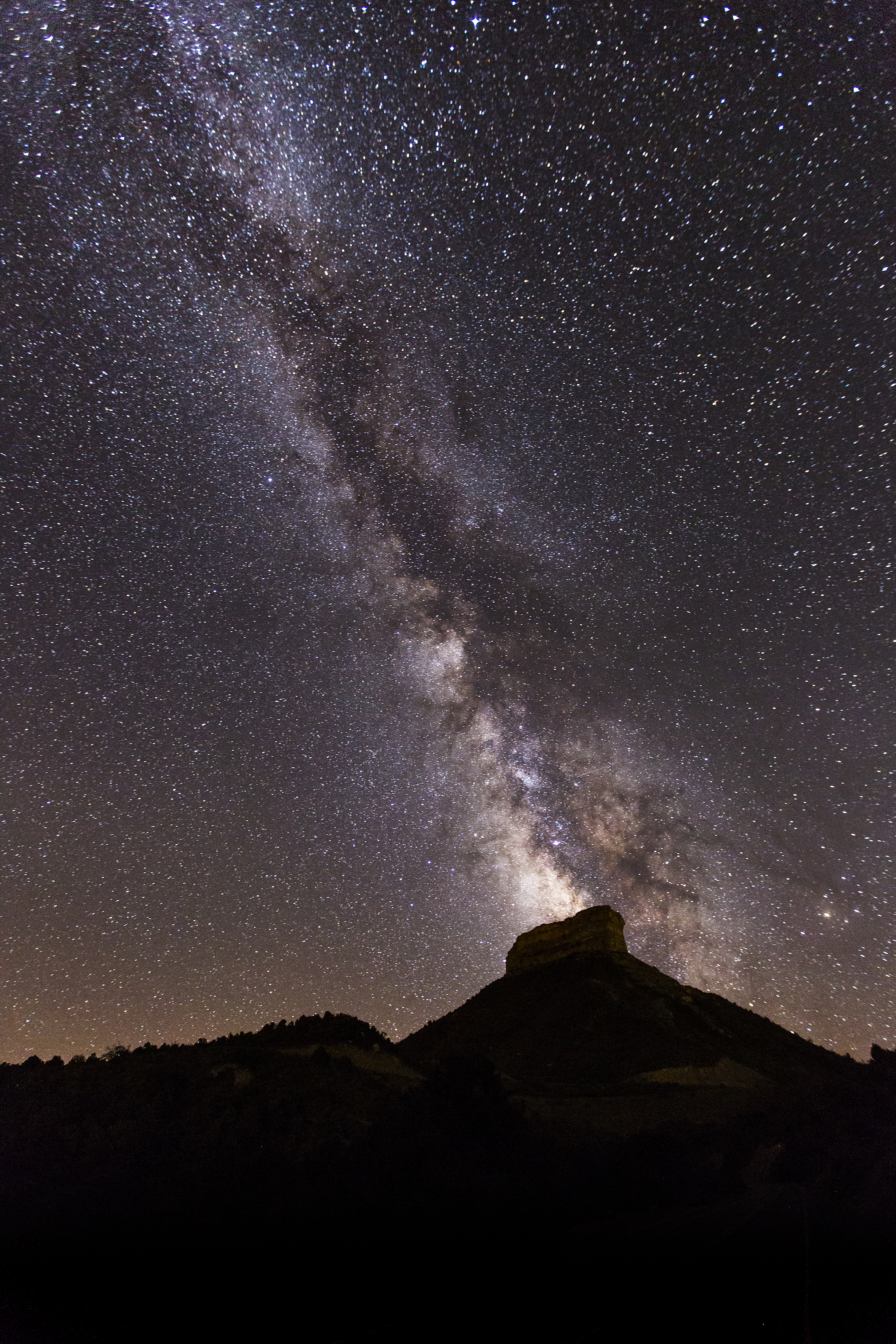
Great Sand Dunes describes the ingredients that make many Colorado sites effective for stargazing: dry air, low light pollution and high elevation. But the NPS page also makes clear that the Milky Way depends on timing, Moonlight and darkness, not elevation alone.[2]
What the Milky Way looks like with your eyes
NPS tells visitors not to expect the color and contrast of a long-exposure photograph. To unaided eyes, the Milky Way appears more like a pale, uneven cloud or band, with structure becoming clearer under darker skies and after adaptation.[3]
A camera can accumulate far more light and color than the eye, so use photographs to understand the landscape, not as a literal promise of the naked-eye view.[3]
Give the sky time to become dark
Great Sand Dunes recommends viewing well after sunset or before sunrise for the greatest number of visible stars. Twilight can leave a sky looking far brighter than it will later in the same night.[4]
The Moon can change the whole result
NPS notes that a bright or full Moon washes out the Milky Way while illuminating the landscape. For faint galactic structure, plan around darker Moon hours; for a moonlit Colorado landscape, deliberately choose the Moon instead.[5][6]
NASA's phase guide also emphasizes that Moon rise and set timing follows the phase, so check the actual hours rather than relying only on an illumination percentage.[5][6]
Summer shows the brighter galactic center
From Colorado, the visually richer Milky Way toward Sagittarius and Scorpius is most convenient during the warmer part of the year. Great Sand Dunes describes summer as the season when the Milky Way can stretch prominently across the night sky, with the central region shifting through the evening as the season advances.[7]
Exact position changes by date and hour, so use a current chart or app for the specific night.[7]
A useful horizon matters
A dark mountain basin can still hide the lower part of the Milky Way behind terrain. For the summer core, inspect the southern and southwestern horizon rather than judging the destination only by an overhead darkness map.[8]
NASA recommends finding an observing location with a broad enough view of the sky for the targets you plan to watch.[8]
Protect dark adaptation
NPS recommends dim red light for stargazing and minimizing bright white light. DarkSky likewise recommends outdoor lighting that is targeted and no brighter than necessary.[9][10]
Give your eyes time away from headlights and bright screens before deciding that a faint Milky Way is not visible.[9][10]
Binoculars reveal the star fields
Astronomy.com describes binoculars as especially effective for sweeping Milky Way star fields because they combine extra light gathering with a wide field of view. Once you see the band with your eyes, scan through it slowly rather than immediately switching to high telescope magnification.[11]
Colorado weather still decides the night
Great Sand Dunes advises checking the forecast for the clearest nights and warns that nighttime temperatures drop even in summer. Smoke, high cloud, storms and wind can reduce a night that looked good on a light-pollution map.[12]
The planning rule
Combine dark sky, useful horizon, legal access, Moon timing, weather and enough comfort to remain outside. The official Colorado Stargazing Trail can identify promising regions; the managing agency and current sky conditions decide whether tonight actually works.[13]
Sources
- [1]
Photo: National Park Service, Jacob W. Frank / NPS, Where to Stargaze — nps.gov/subjects/nightskies/stargaze.htm
- [2]
National Park Service, Great Sand Dunes, Experience the Night — nps.gov/grsa/planyourvisit/experiencethenight.htm
- [3]
National Park Service, Great Sand Dunes, Experience the Night — nps.gov/grsa/planyourvisit/experiencethenight.htm
- [4]
National Park Service, Great Sand Dunes, Experience the Night — nps.gov/grsa/planyourvisit/experiencethenight.htm
- [5]
National Park Service, Great Sand Dunes, Experience the Night — nps.gov/grsa/planyourvisit/experiencethenight.htm
- [6]
NASA Science, Moon Phases — science.nasa.gov/moon/moon-phases
- [7]
National Park Service, Great Sand Dunes, Experience the Night — nps.gov/grsa/planyourvisit/experiencethenight.htm
- [8]
NASA Science, Skywatching Tips & Guides — science.nasa.gov/skywatching/tips-guides
- [9]
National Park Service, Where to Stargaze — nps.gov/subjects/nightskies/stargaze.htm
- [10]
DarkSky International, Five Principles for Responsible Outdoor Lighting — darksky.org/resources/guides-and-how-tos/lighting-princ…
- [11]
Astronomy.com, Using Binoculars — astronomy.com/observing/using-binoculars
- [12]
National Park Service, Great Sand Dunes, Weather — nps.gov/grsa/planyourvisit/weather.htm
- [13]
Colorado Tourism Office, Colorado Stargazing Trail™ — colorado.com/colorado-stargazing-trail