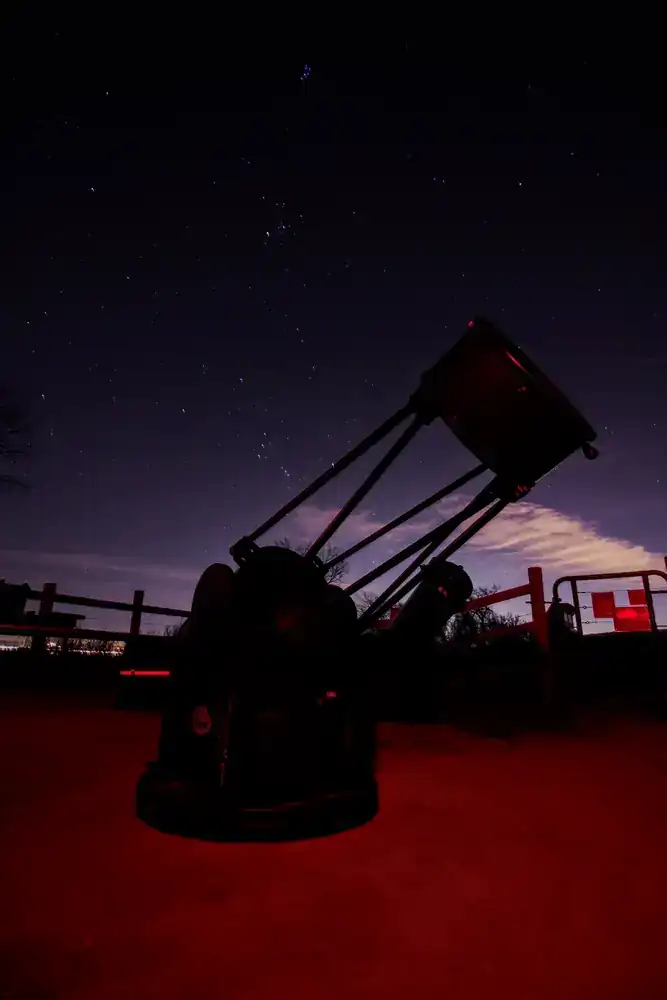
The official Colorado Stargazing Trail includes both places to experience independently and destinations with ranger talks, observatories, local organizations and guided astronomy programming. A place does not need a scheduled program to be a good stargazing stop.[2]
Guided program
Choose a guide when the value is having someone orient you to the sky, operate equipment and interpret what you are seeing. AstroTours.org describes its Colorado programs around astronomer-led viewing through large telescopes and learning the sky rather than simply providing access to a dark field.[3]
Seasonal guided
Many public astronomy programs are seasonal or date-specific. Great Sand Dunes, for example, uses summer and fall evening programs to interpret the night sky and nocturnal ecology rather than offering the same scheduled program every night of the year.[4]
Always open the current organizer calendar before traveling specifically for a program.[4]
Guided + self-guided
Some destinations work both ways: a ranger or observatory program may run on selected nights while the location also has legal independent observing opportunities. The guide labels these separately so the existence of a program is not confused with ordinary after-dark access.[5]
Self-guided
The Planetary Society notes that stargazing can begin with the unaided eye and that binoculars are an easy next step. A self-guided night is well suited to learning constellations, waiting for dark adaptation, watching meteors or using your own telescope and camera on your own schedule.[6]
If you want the independent route without buying equipment first, see which Colorado libraries lend telescopes, binoculars, dark-sky kits and State Parks backpacks.[6]
A guide can accelerate the first night
Sky & Telescope recommends learning a few recognizable patterns and using them as anchors for the rest of the sky. A capable guide can make those anchors obvious quickly, after which a self-guided second night becomes much easier.[7]
Self-guided means the logistics are yours
Without an organizer, access, weather, navigation, lighting, equipment and the return drive remain the visitor's responsibility. NPS recommends checking current conditions, making a trip plan and telling someone where you are going and when you expect to return for after-dark visits.[8]
Sources
- [1]
Photo: AstroTours.org — astrotours.org
- [2]
Colorado Tourism Office, Colorado Stargazing Trail™ — colorado.com/colorado-stargazing-trail
- [3]
AstroTours.org, Blog — astrotours.org/blog
- [4]
National Park Service, Great Sand Dunes, Experience the Night — nps.gov/grsa/planyourvisit/experiencethenight.htm
- [5]
National Park Service, Where to Stargaze — nps.gov/subjects/nightskies/stargaze.htm
- [6]
The Planetary Society, A Beginner's Guide to Stargazing — planetary.org/articles/a-beginners-guide-to-stargazing
- [7]
Sky & Telescope, Stargazing Basics: Learn the Sky — skyandtelescope.org/astronomy-resources/stargazing-basi…
- [8]
National Park Service, Find Your Park After Dark — nps.gov/articles/find-your-park-after-dark.htm