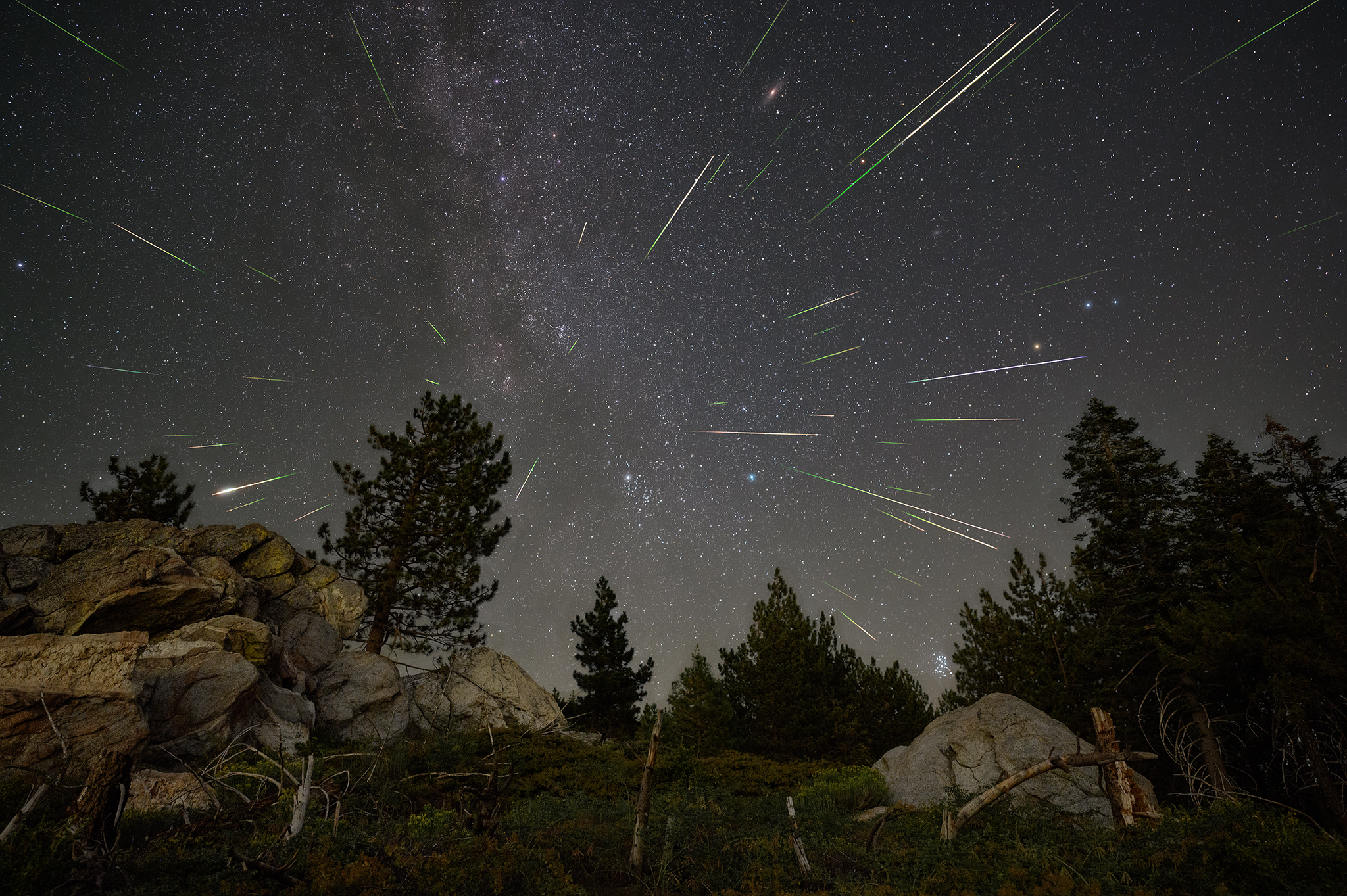
Astronomy.com notes that beginner astrophotography does not require a large telescope setup: a camera and tripod can produce wide-field night-sky photographs. Sky & Telescope similarly recommends learning with simple nightscapes before adding more complex tracking equipment.[2][3]
Start with a stable tripod
NASA's meteor-photography guide puts the tripod near the beginning of the process because long exposures reveal even small camera movement. Set it on firm ground, use a timer or shutter release and avoid touching the camera during the exposure.[4]
Use a wide lens and manual focus
NASA recommends a wide-angle lens for meteor photography and manual focus for the stars. For a first Colorado nightscape, the same approach gives you more sky, more foreground and more tolerance for small pointing errors than a long lens.[5]
Focus on a bright star using a magnified screen when possible, then prevent autofocus from hunting again in the dark.[5]
Exposure is a starting point, not a magic recipe
Shutter time, aperture and ISO depend on focal length, sensor, sky brightness and the result you want. Longer exposures gather more light but eventually show Earth's rotation as star trailing. Take a test frame, inspect the stars and adjust rather than treating one published setting as universal.[6]
The Milky Way will look stronger in the camera
Great Sand Dunes warns visitors that long-exposure photographs show the Milky Way much more dramatically and colorfully than the unaided eye. That is normal camera behavior, not evidence that the real night was disappointing.[7]
Use the photograph as its own interpretation of the sky and keep visual expectations separate.[7]
Phones work best when they stop moving
NASA's Moon photography guidance recommends stabilizing a phone, turning off the flash, using a timer and experimenting with the equipment you already own. Night or astrophotography modes can extend exposure and combine frames, but they still benefit from a fixed support.[8]
The Moon needs a different exposure
The Moon is bright compared with a star field. NASA recommends exposing for the Moon itself, lowering brightness so lunar features remain visible and using a faster exposure than a Milky Way nightscape.[9]
Quarter and crescent phases can also provide dramatic side-lighting and foreground possibilities.[9]
Dark sky and foreground both matter
NASA tells meteor photographers to get away from city lights, while landscape photography also depends on composition. A slightly brighter Colorado site with a strong foreground can be a better photograph than a darker parking lot with no useful scene.[10]
Scout legal access and tripod placement before dark whenever possible.[10]
Add a tracker only when you need one
A star tracker follows the sky so exposures can run longer without stars trailing, but it adds alignment, power and setup. Sky & Telescope's beginner imaging guidance emphasizes mastering a stable camera and basic technique first.[11]
Colorado still controls the field session
Wind, cold, dust and rapidly changing mountain weather affect cameras as much as observers. Great Sand Dunes recommends checking the forecast and bringing warm layers even in summer.[12]
Sources
- [1]
Photo: NASA / Preston Dyches, The Perseids meteor shower peaks in mid-August — science.nasa.gov/image-detail/perseids-radiant-credit-p…
- [2]
Astronomy.com, Astrophotography Without a Scope — astronomy.com/observing/observing-basics-astrophotograp…
- [3]
Sky & Telescope, Getting Started in Deep-Sky Astrophotography — skyandtelescope.org/astronomy-blogs/imaging-foundations…
- [4]
NASA Science, How to Photograph a Meteor Shower — science.nasa.gov/solar-system/how-to-photograph-a-meteo…
- [5]
NASA Science, How to Photograph a Meteor Shower — science.nasa.gov/solar-system/how-to-photograph-a-meteo…
- [6]
Sky & Telescope, Astrophotography Tips — skyandtelescope.org/astronomy-resources/astrophotograph…
- [7]
National Park Service, Great Sand Dunes, Experience the Night — nps.gov/grsa/planyourvisit/experiencethenight.htm
- [8]
NASA Science, Lunar Photography Guide — science.nasa.gov/moon/photography-guide
- [9]
NASA Science, Lunar Photography Guide — science.nasa.gov/moon/photography-guide
- [10]
NASA Science, How to Photograph a Meteor Shower — science.nasa.gov/solar-system/how-to-photograph-a-meteo…
- [11]
Sky & Telescope, Getting Started in Deep-Sky Astrophotography — skyandtelescope.org/astronomy-blogs/imaging-foundations…
- [12]
National Park Service, Great Sand Dunes, Weather — nps.gov/grsa/planyourvisit/weather.htm