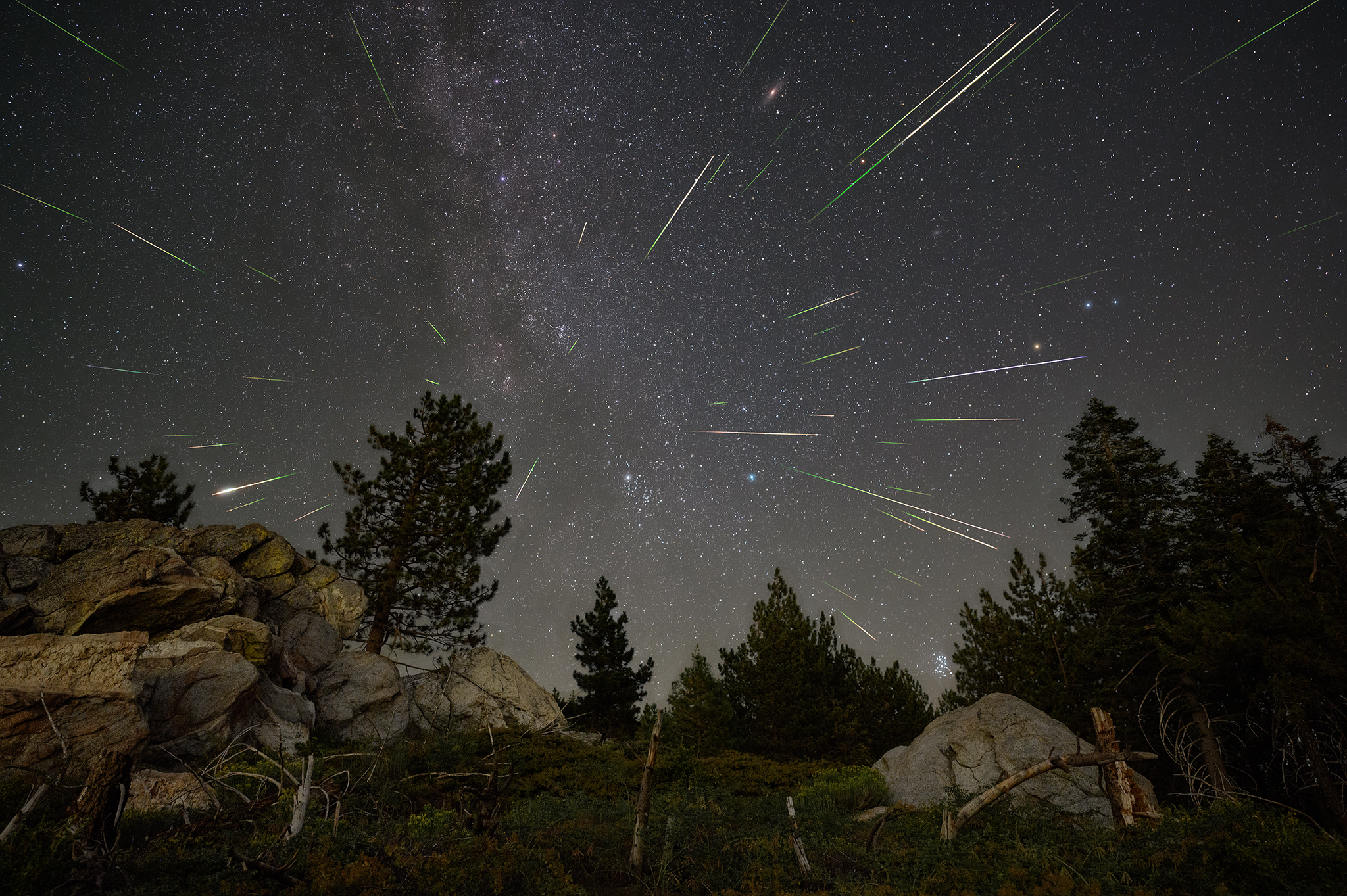
Astronomy.com recommends treating a meteor shower as a comfortable naked-eye watch from a dark site: dress warmly, use a blanket or reclining chair and give yourself a broad view of the sky.[2]
Leave the telescope in the car
A telescope shows a tiny portion of the sky while meteors can appear almost anywhere. For active meteor watching, the unaided eye gives you the useful field of view; binoculars are better saved for other targets between bursts.[3]
What the radiant means
A shower's meteors appear to trace backward toward a point called the radiant. The Perseids radiate from the direction of Perseus because Earth encounters debris associated with comet 109P/Swift-Tuttle.[4]
You do not need to stare at the radiant. NASA notes that meteors can be seen across the sky, and longer trails are often visible farther from the radiant.[4]
After midnight is often productive
For the Perseids, NASA recommends the predawn hours, while Astronomy.com notes that many showers improve after midnight as the radiant rises and the observing location rotates into a favorable geometry.[5][6]
Use the current year's forecast because peak hour and Moon conditions change from one return to the next.[5][6]
Moonlight removes the faint meteors first
A bright Moon does not erase every fireball, but it raises the background sky brightness and hides many faint streaks. Compare the shower's peak with Moon phase and Moon rise/set time when choosing the night.[7]
Choose open sky
For meteors, a broad horizon can be more important than a perfectly level telescope pad. Avoid tall canyon walls, dense trees, bright parking lights and a viewing position that blocks much of the sky.[8]
NASA's current skywatching advice for the Perseids is simple: find a dark spot, bring a blanket or lounge chair and get comfortable.[8]
Give the shower time
Meteor activity comes in bursts and lulls. Do not judge a shower after ten minutes. Let your eyes adapt and plan a session long enough that natural variation does not dominate the experience.[9]
What to bring
- Reclining chair or sleeping pad.[10]
- Warm layers.[10]
- Dim red light.[10]
- Water and snacks.[10]
- Downloaded access information.[10]
- A blanket or sleeping bag when the ground is cold.[10]
- Patience.[10]
Great Sand Dunes reminds visitors that Colorado nights cool quickly even in summer and recommends warm layers, water and snacks for night-sky visits.[10]
Annual showers are recurring; conditions are not
The Perseids, Geminids, Lyrids, Orionids, Leonids and other major showers return each year, but Moonlight, peak timing, weather and smoke change. Use the shower name as the seasonal anchor and a current NASA or astronomy source for the specific year's plan.[11]
Sources
- [1]
Photo: NASA / Preston Dyches, Perseids meteor shower photograph — science.nasa.gov/image-detail/perseids-radiant-credit-p…
- [2]
Astronomy.com, About Meteors and Meteor Showers — astronomy.com/observing/about-meteors-and-meteor-showers
- [3]
Astronomy.com, How to Observe a Meteor Shower — astronomy.com/observing/how-to-observe-a-meteor-shower
- [4]
NASA Science, Perseids Meteor Shower — science.nasa.gov/solar-system/meteors-meteorites/perseids
- [5]
NASA Science, Perseids Meteor Shower — science.nasa.gov/solar-system/meteors-meteorites/perseids
- [6]
Astronomy.com, How to Observe a Meteor Shower — astronomy.com/observing/how-to-observe-a-meteor-shower
- [7]
Astronomy.com, How to Observe a Meteor Shower — astronomy.com/observing/how-to-observe-a-meteor-shower
- [8]
NASA Science, Skywatching Tips & Guides — science.nasa.gov/skywatching/tips-guides
- [9]
EarthSky, Top 10 Stargazing Tips for Beginners — earthsky.org/astronomy-essentials/top-10-stargazing-tips
- [10]
National Park Service, Great Sand Dunes, Experience the Night — nps.gov/grsa/planyourvisit/experiencethenight.htm
- [11]
NASA Science, Meteor Showers — science.nasa.gov/solar-system/meteors-meteorites/meteor…