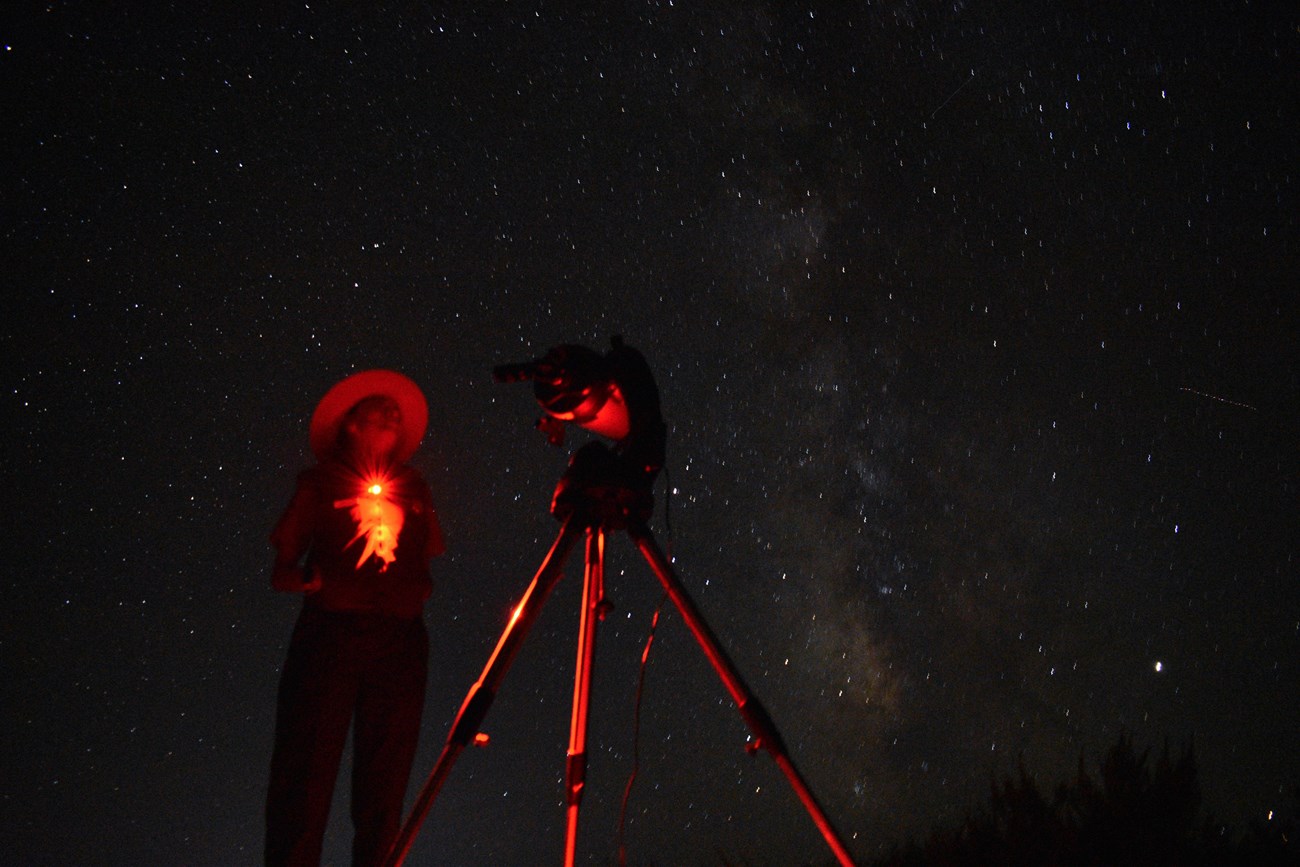
DarkSky defines light pollution as the “human-made alteration of outdoor light levels” from natural conditions. For a stargazer, that includes regional skyglow and very local light from headlights, buildings, phones and campsites.[2]
Let your eyes adapt
NPS recommends allowing time for eyes to adjust to darkness before judging a night sky. Bright light resets that process, which is why a dark site can feel disappointing immediately after stepping out of an illuminated vehicle and much richer later.[3]
Use red light, but keep it dim
Great Sand Dunes tells night visitors: “Use only a red light if needed.” NPS explains that dim red light preserves night vision better than bright white light, but a red lamp can still be disruptive when it is unnecessarily bright or aimed into another observer's face.[4][5]
Phones are part of the lighting environment
A bright screen can undo dark adaptation just as effectively as a lantern. Lower screen brightness before arriving, use a red or night mode for charts where available and avoid repeatedly opening bright white pages in an observing field.[6]
Headlights can defeat an otherwise dark location
Regional darkness does not prevent a nearby road or parking loop from shining directly into an observing area. When comparing sites, look for terrain, barriers or parking orientation that keeps vehicle light away from the telescope field.[7]
The Moon is different from artificial light
A bright Moon reduces contrast in the Milky Way and other faint targets, but it is also a natural part of the sky and one of astronomy's best objects. Great Sand Dunes explicitly describes full-Moon nights as a different experience because moonlight can illuminate the landscape while hiding many stars.[8]
If you control the lighting
DarkSky and the Illuminating Engineering Society organize responsible outdoor lighting around five principles: useful, targeted, low-level, controlled and warm-colored. DarkSky summarizes the goal as using light where and when it is needed, in the amount needed, and no more.[9]
Campground etiquette
The Colorado Tourism Office asks visitors to minimize unnecessary campsite, RV and cabin lighting while enjoying the Stargazing Trail. Turn off lights that are not serving a safety purpose, shield them downward and avoid illuminating neighboring sites.[10]
Safety still comes first
Carry a normal flashlight and use it when the terrain or an emergency requires it. Preserving night vision never justifies driving without required headlights or walking hazardous terrain without enough light to see safely.[11]
Sources
- [1]
Photo: National Park Service / Martin Tow, after-dark stargazing photograph — nps.gov/articles/find-your-park-after-dark.htm
- [2]
DarkSky International, What Is Light Pollution? — darksky.org/resources/what-is-light-pollution
- [3]
National Park Service, Where to Stargaze — nps.gov/subjects/nightskies/stargaze.htm
- [4]
National Park Service, Great Sand Dunes, Experience the Night — nps.gov/grsa/planyourvisit/experiencethenight.htm
- [5]
National Park Service, How Light Works — nps.gov/subjects/nightskies/how-light-works.htm
- [6]
National Park Service, Where to Stargaze — nps.gov/subjects/nightskies/stargaze.htm
- [7]
DarkSky International, Responsible Outdoor Lighting — darksky.org/resources/what-is-light-pollution/light-pol…
- [8]
National Park Service, Great Sand Dunes, Experience the Night — nps.gov/grsa/planyourvisit/experiencethenight.htm
- [9]
DarkSky International, Five Principles for Responsible Outdoor Lighting — darksky.org/resources/guides-and-how-tos/lighting-princ…
- [10]
Colorado Tourism Office, Colorado Stargazing Trail Launch / Responsible Stargazing — colorado.com/news/the-colorado-tourism-office-launches-…
- [11]
National Park Service, Find Your Park After Dark — nps.gov/articles/find-your-park-after-dark.htm