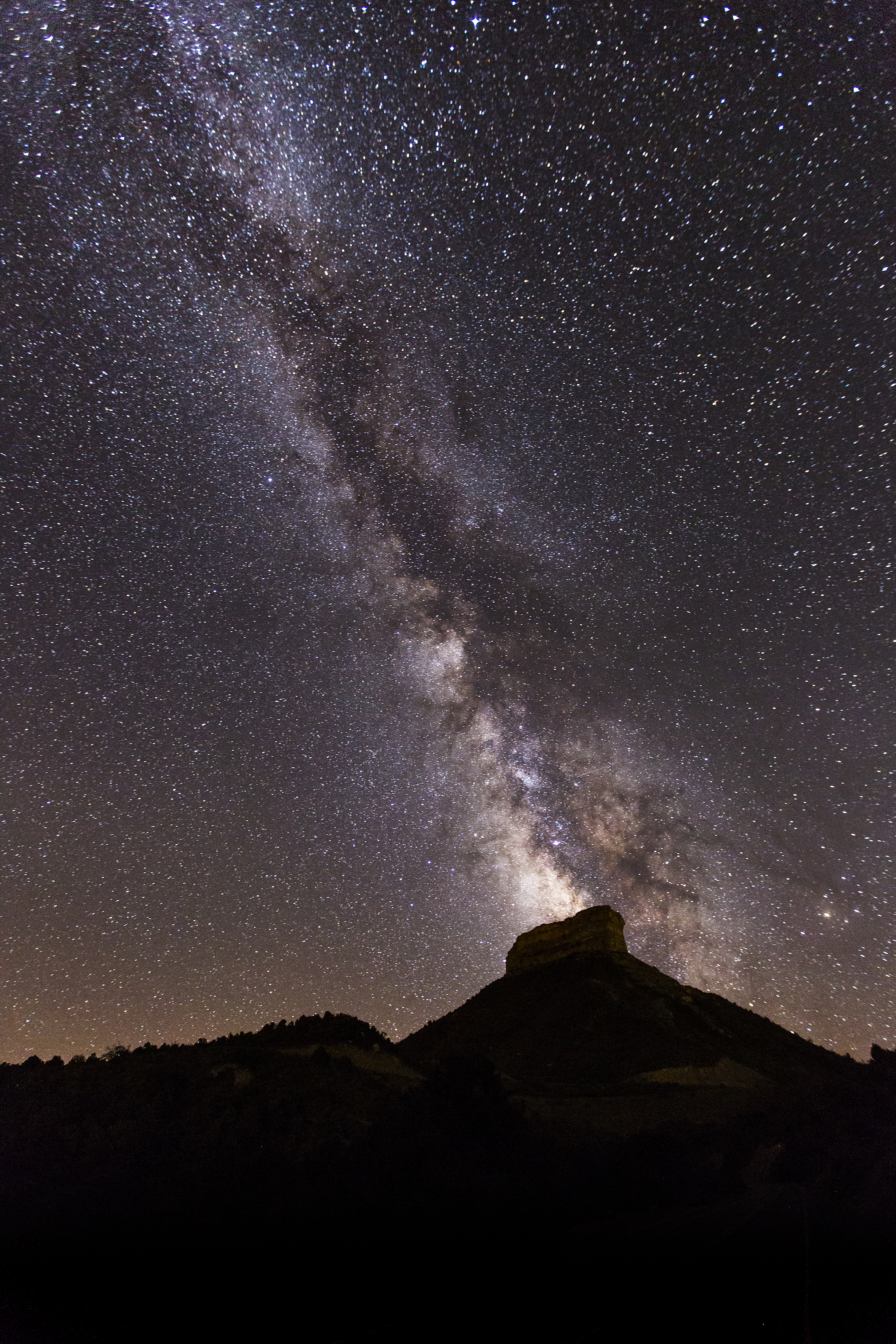
September is a transition between the summer and autumn sky. The Summer Triangle remains prominent after dark while Pegasus, Andromeda and Cassiopeia become increasingly useful later in the evening.[2]
The late-season Milky Way is still worth planning for
The brighter central Milky Way is still available in the early part of September evenings, but it moves toward the southwest earlier than in midsummer. A dark site with a low southern and southwestern horizon becomes particularly useful because the observing window is shorter.[3]
The dark-Moon window centers on September 10–11
The U.S. Naval Observatory lists New Moon at 03:27 UTC on September 11, which is 9:27 p.m. MDT on September 10 in Colorado. Nights around that date provide the month's strongest window for faint Milky Way structure and other low-contrast targets, weather and smoke permitting.[4]
September's primary Moon phases
The U.S. Naval Observatory lists Last Quarter on September 4, New Moon on September 11 UTC, First Quarter on September 18 and Full Moon on September 26. The exact useful darkness on any one night also depends on Moon rise and set time.[5]
International Observe the Moon Night is September 19
NASA's official 2026 date is Saturday, September 19. NASA chooses dates near First Quarter because the Moon is conveniently visible in the afternoon and evening and the terminator gives strong views of lunar terrain.[6][7]
This is a good night for binoculars, telescopes and public observing without needing an extremely dark destination.[6][7]
Use the 2026 Moon map
NASA publishes a Northern Hemisphere Moon map specifically for September 19, 2026, marking maria, landforms and landing sites that are well positioned near the terminator.[8]
The September equinox is September 22 in Colorado
NASA gives the 2026 September equinox as September 23 at 00:05 UTC, which is September 22 at 6:05 p.m. MDT in Colorado. The equinox marks the Sun crossing the plane of Earth's equator and the seasonal shift toward longer autumn nights in the Northern Hemisphere.[9]
Look for Andromeda as autumn rises
As September progresses, the Great Square of Pegasus and Andromeda become easier to use later in the evening. Under sufficiently dark skies, the Andromeda Galaxy can be detected as a faint extended glow with the unaided eye and is much easier in binoculars.[10]
What kind of site works best
For the early-evening Milky Way, prioritize darkness and a low southern/southwestern horizon. For International Observe the Moon Night, convenient legal access and a clear view of the Moon are more important than extreme darkness. For Andromeda later at night, an open eastern and northeastern sky helps.[11]
September can feel colder than the afternoon suggests
Great Sand Dunes' weather guidance shows how sharply high-elevation Colorado temperatures can drop through fall. Pack for the temperature after an hour sitting outside rather than the temperature at sunset.[12]
Sources
- [1]
Photo: National Park Service, Jacob W. Frank / NPS, Where to Stargaze — nps.gov/subjects/nightskies/stargaze.htm
- [2]
Sky & Telescope, Stargazing Basics — skyandtelescope.org/astronomy-resources/stargazing-basics
- [3]
National Park Service, Great Sand Dunes, Experience the Night — nps.gov/grsa/planyourvisit/experiencethenight.htm
- [4]
U.S. Naval Observatory, Dates of Primary Phases of the Moon — 2026 — aa.usno.navy.mil/calculated/moon/phases
- [5]
U.S. Naval Observatory, Dates of Primary Phases of the Moon — 2026 — aa.usno.navy.mil/calculated/moon/phases
- [6]
NASA Science, International Observe the Moon Night — science.nasa.gov/moon/observe-the-moon-night
- [7]
NASA Science, International Observe the Moon Night FAQ — science.nasa.gov/moon/observe-the-moon-night/faq
- [8]
NASA Science, 2026 Moon Maps for International Observe the Moon Night — science.nasa.gov/resource/2026-moon-maps-for-internatio…
- [9]
NASA Science / Night Sky Network, Embracing the Equinox — science.nasa.gov/solar-system/skywatching/night-sky-net…
- [10]
Astronomy.com, Using Binoculars — astronomy.com/observing/using-binoculars
- [11]
NASA Science, Skywatching Tips & Guides — science.nasa.gov/skywatching/tips-guides
- [12]
National Park Service, Great Sand Dunes, Weather — nps.gov/grsa/planyourvisit/weather.htm