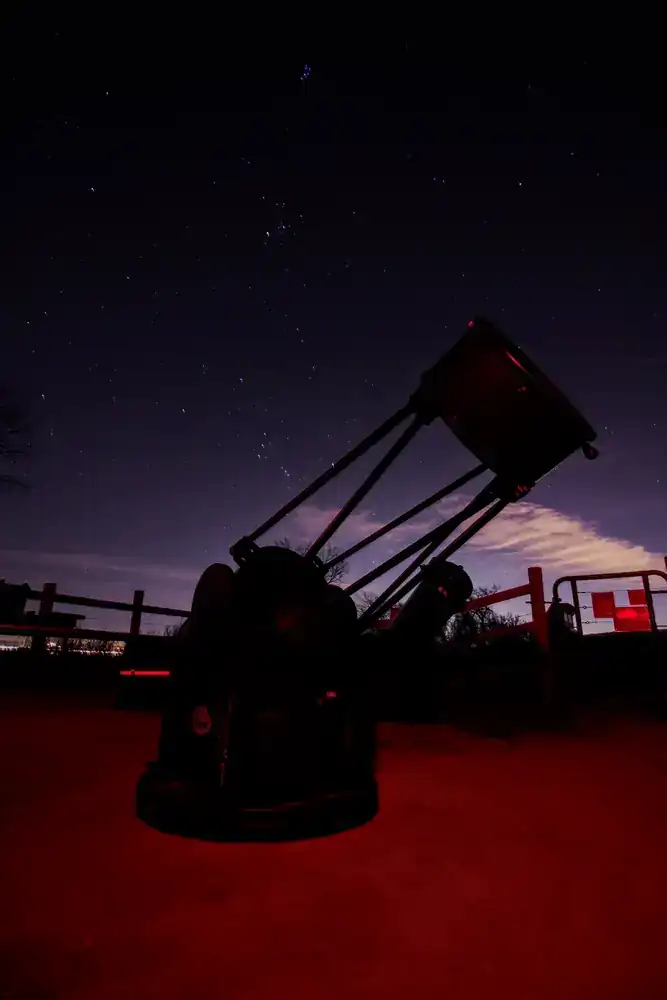
The Planetary Society notes that “You don’t need a telescope to stargaze.” Start with targets that fit the instrument you actually have, then add magnification when it reveals something useful.[2]
Naked eye
The unaided eye is best for the largest structures and the geometry of the whole sky: constellations, bright stars and planets, the Moon, meteor showers and the Milky Way from a dark site.[3]
Sky & Telescope recommends learning recognizable sky patterns before chasing small targets, because those patterns become the reference points for everything else.[3]
Binoculars
Astronomy.com highlights the Moon, Milky Way star fields, large star clusters, comets and larger deep-sky objects as strong binocular targets. The wide field makes binoculars especially useful for the Pleiades, Beehive Cluster and Andromeda Galaxy.[4]
Telescope
A telescope trades field of view for light gathering, resolution and magnification. Astronomy.com recommends starting with bright, forgiving objects such as the Moon and planets, then moving into double stars, clusters, nebulae and galaxies as the observer learns the instrument.[5]
The Moon and planets work from brighter places
Extreme darkness is not required for bright objects. A city observatory can still provide excellent views of lunar craters, Jupiter's moons, Saturn's rings when visible and bright double stars.[6]
That is why the destination guide does not score every location only by its faintest possible target.[6]
Faint objects need contrast more than high magnification
Galaxies, nebulae and Milky Way structure benefit strongly from dark sky and dark adaptation. More magnification cannot restore contrast lost to skyglow, Moonlight or a bright fixture shining into the observing area.[7]
Galaxies and nebulae usually are not brightly colored to the eye
Great Sand Dunes specifically warns visitors that night photographs show much more color than the unaided eye. The same expectation applies at a telescope: many faint galaxies and nebulae appear gray or only subtly tinted because human low-light vision sacrifices color sensitivity.[8]
Cameras show a different sky
Long exposures collect light over time, allowing a camera to reveal color and faint structure the eye cannot accumulate in the same way. That makes astrophotography valuable, but it is not a literal preview of visual observing.[9]
Pick targets for the destination
A remote Dark Sky Park is especially valuable for faint structures. An urban observatory can be excellent for bright solar-system targets and guided learning. A broad open plain can be better for meteors than a darker canyon with half the sky blocked.[10]
Use each place page's practical strengths to choose the target list rather than expecting every stop to excel at everything.[10]
Sources
- [1]
Photo: AstroTours.org — astrotours.org
- [2]
The Planetary Society, A Beginner's Guide to Stargazing — planetary.org/articles/a-beginners-guide-to-stargazing
- [3]
Sky & Telescope, Stargazing Basics — skyandtelescope.org/astronomy-resources/stargazing-basics
- [4]
Astronomy.com, Using Binoculars — astronomy.com/observing/using-binoculars
- [5]
Astronomy.com, Using a Telescope — astronomy.com/observing/using-a-telescope
- [6]
Astronomy.com, Using a Telescope — astronomy.com/observing/using-a-telescope
- [7]
DarkSky International, What Is Light Pollution? — darksky.org/resources/what-is-light-pollution
- [8]
National Park Service, Great Sand Dunes, Experience the Night — nps.gov/grsa/planyourvisit/experiencethenight.htm
- [9]
NASA Science, How to Photograph a Meteor Shower — science.nasa.gov/solar-system/how-to-photograph-a-meteo…
- [10]
NASA Science, Skywatching Tips & Guides — science.nasa.gov/skywatching/tips-guides