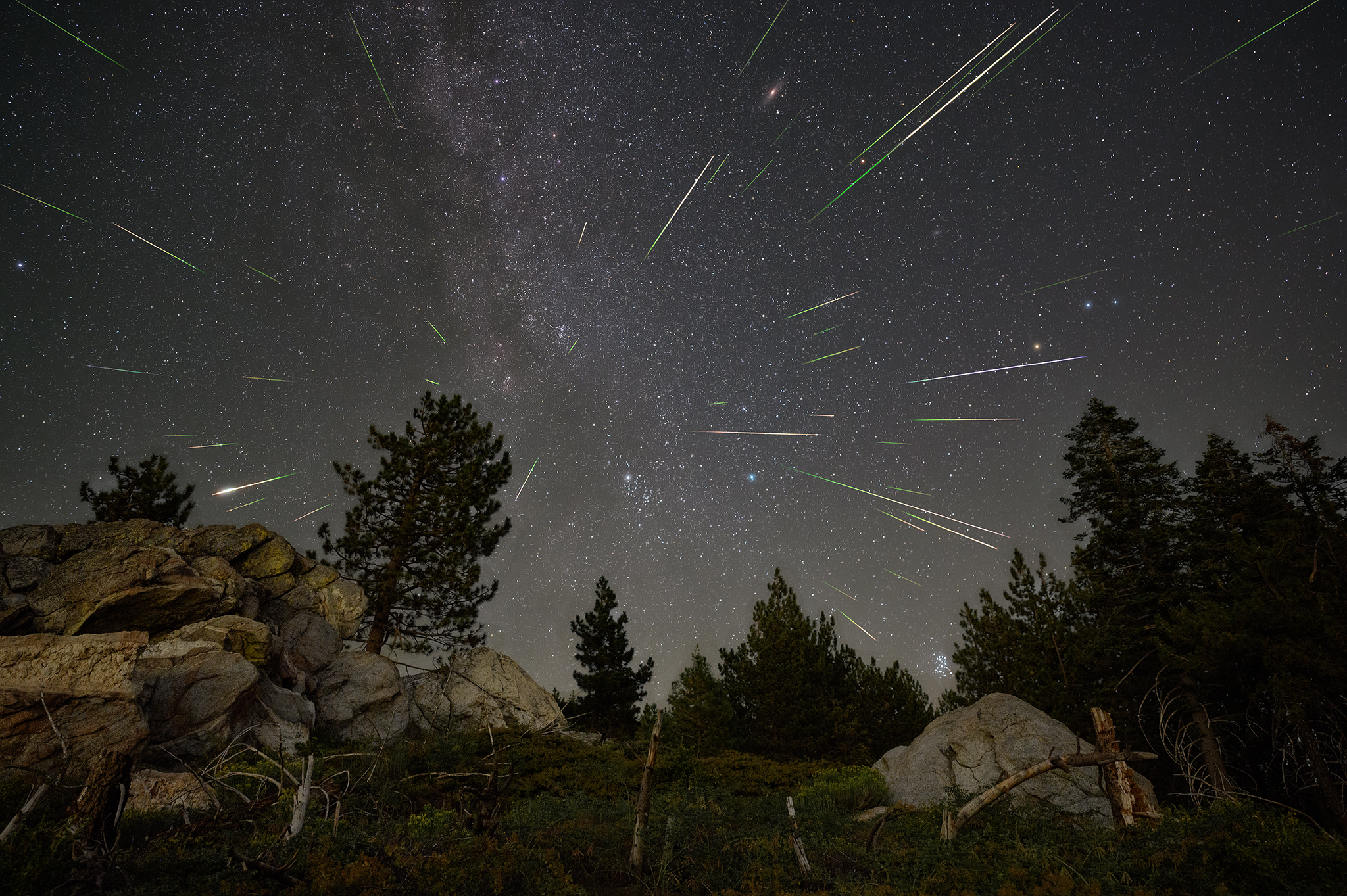
NASA's August 2026 skywatching guide highlights the Perseids, bright evening Venus and the August 27–28 partial lunar eclipse. As of August 18, the meteor-shower peak is behind us, while the eclipse is still ahead.[2]
The summer sky is still in place
The Summer Triangle remains easy to find after dark, with Vega, Deneb and Altair spanning a large part of the sky. From a dark site, the Milky Way runs through Cygnus and Aquila and continues toward the richer southern star fields.[3][4]
For the most dramatic Milky Way view, choose a legal location with a dark southern or southwestern horizon and give the sky time to become fully dark.[3][4]
The Perseid peak has passed, but the shower is not instantly over
NASA lists the main Perseid peak on August 12–13 under New Moon. Astronomy.com lists the 2026 shower as active into late August, so occasional Perseids can still appear after the peak even though rates are much lower.[5][6]
For meteors, use a dark open sky and the unaided eye rather than a telescope.[5][6]
Venus is the obvious evening planet
NASA identifies Venus as a bright object low in the western sky after sunset in mid-August. Its greatest eastern elongation occurred around August 14–16, so it remains a straightforward early-evening target rather than a midnight object.[7]
The August 27–28 partial lunar eclipse is the next major event
NASA lists a partial lunar eclipse on August 27–28 visible across the Americas and parts of Europe and Africa. At maximum, most of the Moon enters Earth's dark central shadow, producing a strongly darkened and potentially copper-colored section without becoming a total eclipse.[8][9]
A lunar eclipse is safe to watch directly. Binoculars or a small telescope make the moving edge of Earth's shadow easier to inspect.[8][9]
Moonlight increases toward the eclipse
The U.S. Naval Observatory lists New Moon on August 12 and Full Moon on August 28 UTC. That means faint Milky Way observing becomes progressively more affected by Moonlight as the month moves toward the eclipse.[10]
Check Moon rise and set time for the exact night rather than treating the whole second half of August as equally bright.[10]
What kind of Colorado site works now
For the remaining August Milky Way, favor a dark site with a broad southern and southwestern horizon. For the lunar eclipse, clear weather and an unobstructed view of the Moon matter more than reaching the darkest Bortle class.[11]
Pack for the nighttime temperature
Great Sand Dunes notes that even summer nights at elevation can become cold and that afternoon thunderstorms are common in the warmer season. Bring layers, water, a dim red light and enough time to stay after twilight.[12]
Sources
- [1]
Photo: NASA / Preston Dyches, Perseids meteor shower photograph — science.nasa.gov/image-detail/perseids-radiant-credit-p…
- [2]
NASA Science, What's Up: August 2026 Skywatching Tips from NASA — science.nasa.gov/solar-system/whats-up-august-2026-skyw…
- [3]
NASA Science, Skywatching Tips & Guides — science.nasa.gov/skywatching/tips-guides
- [4]
National Park Service, Great Sand Dunes, Experience the Night — nps.gov/grsa/planyourvisit/experiencethenight.htm
- [5]
NASA Science, What's Up: August 2026 Skywatching Tips from NASA — science.nasa.gov/solar-system/whats-up-august-2026-skyw…
- [6]
Astronomy.com, August 2026: What's in the Sky This Month? — astronomy.com/observing/sky-this-month-august-2026
- [7]
NASA Science, What's Up: August 2026 Skywatching Tips from NASA — science.nasa.gov/solar-system/whats-up-august-2026-skyw…
- [8]
NASA Science, What's Up: August 2026 Skywatching Tips from NASA — science.nasa.gov/solar-system/whats-up-august-2026-skyw…
- [9]
NASA Science, Future Eclipses — science.nasa.gov/eclipses/future-eclipses
- [10]
U.S. Naval Observatory, Dates of Primary Phases of the Moon — 2026 — aa.usno.navy.mil/calculated/moon/phases
- [11]
National Park Service, Great Sand Dunes, Experience the Night — nps.gov/grsa/planyourvisit/experiencethenight.htm
- [12]
National Park Service, Great Sand Dunes, Weather — nps.gov/grsa/planyourvisit/weather.htm