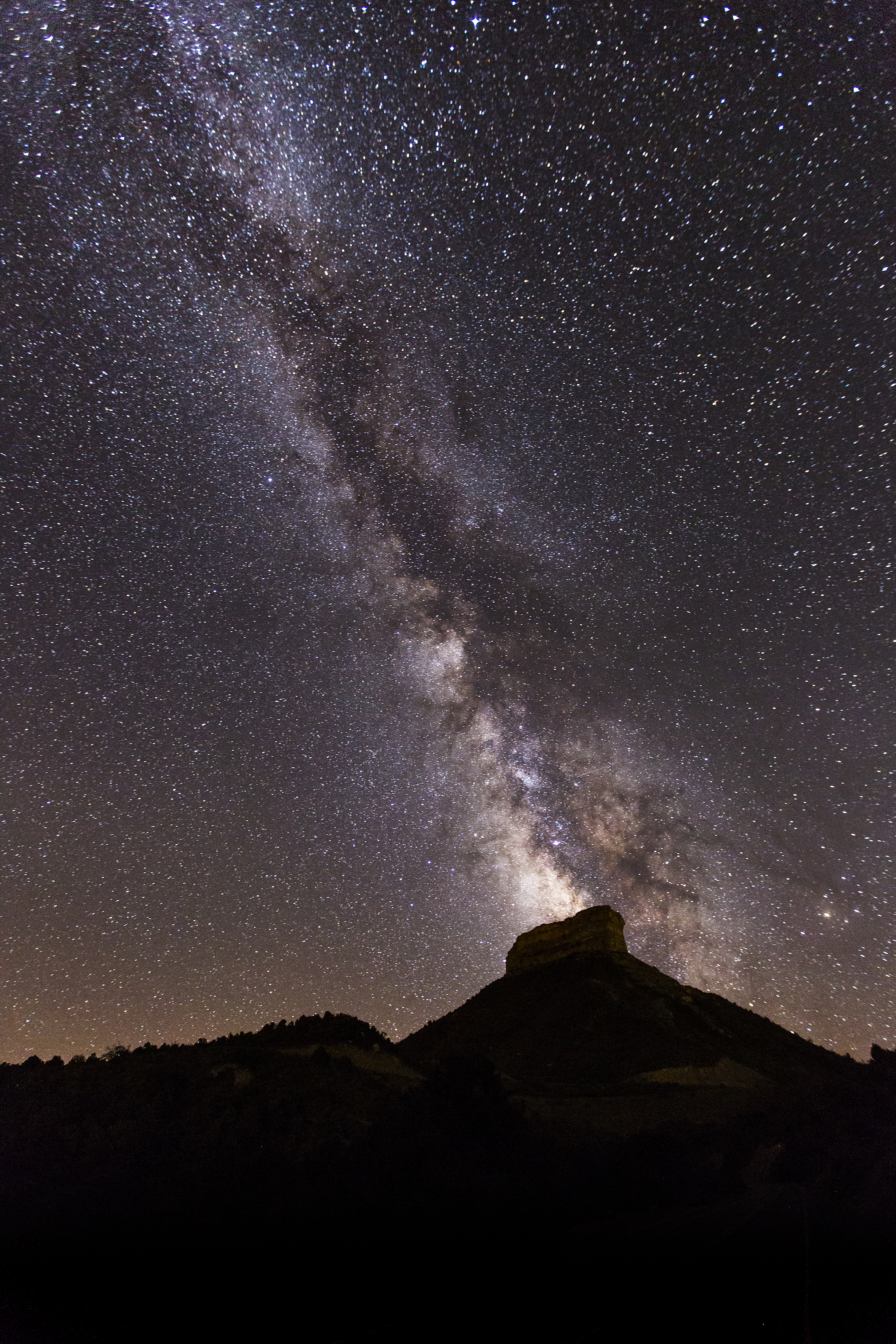
NASA's beginner skywatching guidance starts with finding a place that is dark enough to reveal the sky but also practical to use. In Colorado, the useful site is the combination of darkness, legal access, safe arrival, horizon, weather and the target you want to see.[2]
Start with what you want to see
For Milky Way observing, prioritize darkness and a useful southern horizon. For meteors, prioritize a broad open sky. For the Moon and bright planets, convenient access can matter more than extreme darkness. For photography, add foreground and tripod stability. For telescope observing, add room, stable ground and low wind.[3]
The Planetary Society recommends beginning with naked-eye targets and using binoculars as a simple next step rather than assuming every night needs the same equipment.[3]
If you are planning a self-guided night but do not own optics, look for a Colorado library that lends binoculars, telescopes, dark-sky kits or a State Parks backpack, then choose a site that fits the borrowed equipment.[3]
Check legal nighttime access first
NPS recommends checking current conditions, closures and the rules for the exact park area before an after-dark visit. A place shown on a map can still have a sunset gate, seasonal road or day-use restriction.[4]
Know the parking and return route
Arrive knowing where the legal parking area is and how you will leave it after dark. NPS recommends offline navigation where service may be weak and a complete trip plan shared with someone who is not traveling with you.[5]
Darkness includes local lights
DarkSky defines light pollution as the human-made alteration of natural outdoor light levels. A broadly dark region can still have one parking fixture, campground lantern or stream of headlights that dominates the observing area.[6][7]
DarkSky's lighting guidance favors light that is useful, targeted, low-level, controlled and warm-colored.[6][7]
Look at the horizon, not only the map color
Great Sand Dunes notes that the Milky Way's brighter central region is seasonal and appears in a particular part of the sky. A mountain ridge can therefore block the object you drove out to see even when the sky overhead is exceptionally dark.[8]
Add the Moon
A bright Moon reduces contrast in faint stars and the Milky Way, while moonlight can illuminate landscapes. Check phase and rise/set timing rather than labeling every bright-Moon night bad.[9]
Add weather, smoke and wind
Great Sand Dunes advises visitors to “Watch the weather forecast” when planning night-sky viewing. In Colorado, clear-looking weather can still include high cloud, smoke, strong wind or rapidly falling temperatures that change the value of an exposed site.[10][11]
Check facilities and cell service separately
NPS warns that mobile service may be absent and recommends downloading maps before leaving coverage. Similarly, a facility shown on a daytime map may follow seasonal or visitor-center hours rather than nighttime access.[12]
Use the official trail as the start, not the final access authority
The Colorado Tourism Office presents the Colorado Stargazing Trail as a statewide collection of certified dark-sky parks and communities. Use it to discover the region, then use the actual land manager or operator for the final access, road, program and facility check.[13]
A good site is one you can actually use
A slightly brighter site with legal access, safe parking and a clear horizon can outperform a darker site you cannot comfortably remain at. That is why this guide keeps darkness, access, road, facilities, camping and telescope setup as separate fields.[14]
Sources
- [1]
Photo: National Park Service, Jacob W. Frank / NPS, Where to Stargaze — nps.gov/subjects/nightskies/stargaze.htm
- [2]
NASA Science, Skywatching Tips & Guides — science.nasa.gov/skywatching/tips-guides
- [3]
The Planetary Society, A Beginner's Guide to Stargazing — planetary.org/articles/a-beginners-guide-to-stargazing
- [4]
National Park Service, Find Your Park After Dark — nps.gov/articles/find-your-park-after-dark.htm
- [5]
National Park Service, Trip Planning Guide — nps.gov/subjects/healthandsafety/trip-planning-guide.htm
- [6]
DarkSky International, What Is Light Pollution? — darksky.org/resources/what-is-light-pollution
- [7]
DarkSky International, Five Principles for Responsible Outdoor Lighting — darksky.org/resources/guides-and-how-tos/lighting-princ…
- [8]
National Park Service, Great Sand Dunes, Experience the Night — nps.gov/grsa/planyourvisit/experiencethenight.htm
- [9]
NASA Science, Moon Phases — science.nasa.gov/moon/moon-phases
- [10]
National Park Service, Great Sand Dunes, Experience the Night — nps.gov/grsa/planyourvisit/experiencethenight.htm
- [11]
National Park Service, Great Sand Dunes, Weather — nps.gov/grsa/planyourvisit/weather.htm
- [12]
National Park Service, Trip Planning Guide — nps.gov/subjects/healthandsafety/trip-planning-guide.htm
- [13]
Colorado Tourism Office, Colorado Stargazing Trail™ — colorado.com/colorado-stargazing-trail
- [14]
NASA Science, Skywatching Tips & Guides — science.nasa.gov/skywatching/tips-guides