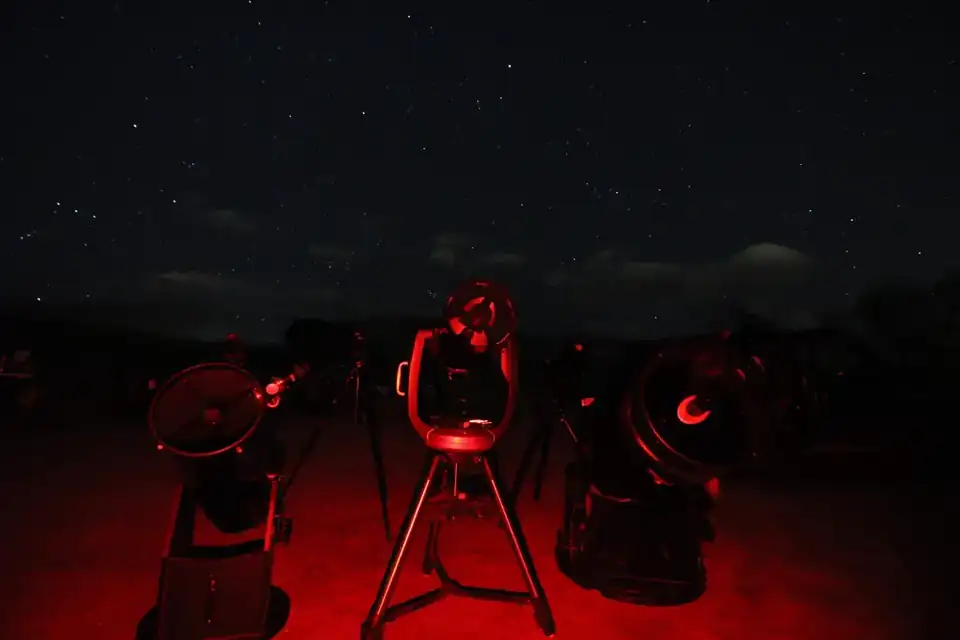
The official Colorado Stargazing Trail shows that night-sky tourism in Colorado can take many forms: national parks, communities, observatories, ranger programs and destination experiences. A useful astronomy program should therefore follow the place rather than forcing every destination into the same format.[2]
Start with the site, not the telescope
DarkSky's responsible-lighting framework is a practical first audit for any destination considering astronomy: light should be useful, targeted, low-level, controlled and warm-colored. A program cannot fully compensate for an observing area flooded by unnecessary direct light.[3]
Decide what the guest experience is supposed to be
A destination program might be a recurring telescope tour, a seasonal ranger-style event, a resort amenity, a community star party, an educational program or a private-group experience. The official Colorado trail already contains examples across several of those models.[4]
Define the audience, capacity, timing and purpose before choosing equipment.[4]
Design around real nighttime conditions
NPS after-dark guidance emphasizes access, weather, lighting, navigation and safe movement after dark. Those same practical issues belong in program design: guest arrival, parking, paths, telescope placement, weather decisions, accessible viewing and the end-of-night departure all need an operating plan.[5]
Equipment should fit the operating model
Astronomy.com emphasizes that usable aperture, mounting and ease of operation matter more than flashy magnification. For a destination, equipment also needs to survive repeated setup, staff handoffs, guest queues, transport and the site's wind and ground conditions.[6]
Lighting is part of the program, not background infrastructure
DarkSky's guidance recommends lighting only where and when it is needed. That can mean shielding fixtures, lowering levels, controlling timing and identifying a dedicated observing zone where guest eyes can adapt without being hit by headlights or building lights.[7]
Train staff to interpret, not only operate equipment
AstroTours.org describes guided astronomy as helping guests connect the dots in the sky, answer questions and understand what they are seeing rather than treating the telescope as a self-explanatory attraction.[8]
A repeatable program therefore needs interpretive content, equipment procedures, weather decisions and a staff training plan.[8]
Test before treating the program as finished
A pilot night reveals guest flow, focus problems, lighting conflicts, setup time and accessibility issues that are easy to miss on paper. NPS public astronomy programs demonstrate the value of defined observing areas and staffed interpretation around equipment.[9]
Stargazing Solutions' current service model
Stargazing Solutions describes its work around destination assessment, program design, equipment planning, procedures, staff training, pilot programs and launch support. The service is intended for destinations that want help building or improving a repeatable astronomy experience rather than simply adding “stargazing” to an amenities list.[10]
Independence
ColoradoStargazingTrail.com is independent from Stargazing Solutions. This Field Manual entry exists as an operator resource because documenting stargazing destinations also exposes places with strong night-sky potential but little or no usable astronomy programming.[11]
Sources
- [1]
Photo: AstroTours.org — astrotours.org
- [2]
Colorado Tourism Office, Colorado Stargazing Trail™ — colorado.com/colorado-stargazing-trail
- [3]
DarkSky International, Five Principles for Responsible Outdoor Lighting — darksky.org/resources/guides-and-how-tos/lighting-princ…
- [4]
Colorado Tourism Office, Colorado Stargazing Trail™ — colorado.com/colorado-stargazing-trail
- [5]
National Park Service, Find Your Park After Dark — nps.gov/articles/find-your-park-after-dark.htm
- [6]
Astronomy.com, How to Buy Your First Telescope — astronomy.com/observing/how-to-buy-your-first-telescope
- [7]
DarkSky International, Responsible Outdoor Lighting — darksky.org/resources/what-is-light-pollution/light-pol…
- [8]
AstroTours.org, Blog — Guided Stargazing Makes the Sky Easier to Love — astrotours.org/blog
- [9]
National Park Service, Dinosaur National Monument, Night Sky — nps.gov/dino/planyourvisit/stargazing.htm
- [10]
Stargazing Solutions, Program development services — stargazingsolutions.com
- [11]
Stargazing Solutions — stargazingsolutions.com