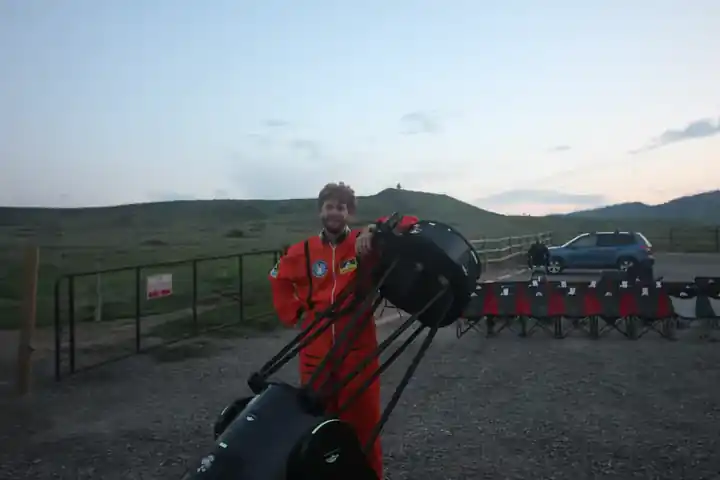
Astronomy.com's current first-telescope guide emphasizes matching the instrument to the observer rather than buying from a magnification number or feature list. Portability, mounting and ease of use determine whether a telescope gets used after the novelty wears off.[2]
Binoculars are a legitimate first instrument
NASA describes binoculars as “A Great First Telescope.” Sky & Telescope and EarthSky make the same beginner recommendation because binoculars are wide-field, portable and useful even after a telescope is added.[3][4]
Aperture matters more than the number on the box
A telescope's aperture is the diameter of its main light-collecting lens or mirror. Astronomy.com cautions against choosing a telescope by advertised extreme magnification; useful magnification depends on aperture, optics, atmosphere and a stable mount.[5]
The mount is part of the telescope
Astronomy.com stresses that a shaky or difficult mount can make otherwise good optics frustrating. A useful first setup should point smoothly and settle quickly after focusing or moving the tube.[6]
For a Dobsonian, the simple alt-azimuth base is part of why the design gives beginners a lot of usable aperture without a complicated tripod system.[6]
Dobsonian: simple aperture for visual observing
A modest Dobsonian is a common recommendation for visual astronomy because the design puts much of the budget into mirror aperture and a simple mount. It works well for the Moon, planets, clusters, nebulae and brighter galaxies when the instrument is practical to transport.[7]
The tradeoff is physical size. Measure the vehicle and storage space before buying.[7]
Compact telescope: portability first
Compact catadioptric telescopes such as Maksutov- and Schmidt-Cassegrain designs can put longer focal lengths into shorter tubes. That can be useful for travel and Moon/planet observing, but narrower fields and mounting requirements make them a different experience from a wide-field refractor or Dobsonian.[8]
Small refractor: quick and wide-field
Small refractors can be simple grab-and-go instruments with wide views that suit open clusters, the Moon and sweeping star fields. As with every tripod-mounted telescope, a stable mount matters at least as much as a promising optical tube.[9]
GoTo and tracking are useful tools, not requirements
Computerized pointing and tracking can help with public observing, repeated targets and imaging, but they also add alignment, power and electronics. A manual telescope remains entirely capable of serious visual observing.[10]
Choose automation because it solves a problem you actually have, not because a first telescope is supposed to be computerized.[10]
Try before you buy
Astronomy.com recommends getting hands-on experience where possible. A local astronomy club or public observatory can show you how different telescope sizes, mounts and eyepieces feel in the dark before you commit money and storage space.[11]
Colorado libraries offer another way to test the idea on your own time: see the verified libraries that lend telescopes, binoculars and dark-sky gear.[11]
Colorado adds a transport question
Ask whether the complete telescope fits in the vehicle, can be carried to the observing area, remains stable on the expected ground and can be operated with cold hands. A telescope that is technically superior but stays home is not the better Colorado road-trip instrument.[12]
Solar observing has one non-negotiable rule
Never look at the Sun through a telescope, binoculars or finder without a proper front-mounted solar filter designed for the instrument. NASA warns that ordinary sunglasses and eclipse glasses are not telescope filters.[13]
Sources
- [1]
Photo: AstroTours.org — astrotours.org
- [2]
Astronomy.com, How to Buy Your First Telescope — astronomy.com/observing/how-to-buy-your-first-telescope
- [3]
NASA Science, Skywatching Tips & Guides — science.nasa.gov/skywatching/tips-guides
- [4]
Sky & Telescope, Astronomy Resources — skyandtelescope.org/astronomy-information
- [5]
Astronomy.com, Buying a Telescope — astronomy.com/observing/buying-a-telescope
- [6]
Astronomy.com, How to Buy Your First Telescope — astronomy.com/observing/how-to-buy-your-first-telescope
- [7]
Sky & Telescope, Choosing Your First Telescope resources — skyandtelescope.org/astronomy-equipment/choosing-astron…
- [8]
Astronomy.com, How to Buy Your First Telescope — astronomy.com/observing/how-to-buy-your-first-telescope
- [9]
Sky & Telescope, Choosing Your First Telescope resources — skyandtelescope.org/astronomy-equipment/choosing-astron…
- [10]
Astronomy.com, Buying a Telescope — astronomy.com/observing/buying-a-telescope
- [11]
Astronomy.com, Buying a Telescope — astronomy.com/observing/buying-a-telescope
- [12]
National Park Service, Find Your Park After Dark — nps.gov/articles/find-your-park-after-dark.htm
- [13]
NASA Science, Eclipse Safety — science.nasa.gov/eclipses/safety